
Ritual Atlas planning for PoE2 0.5
PoE2 Ritual Atlas Tree Guide: choose points before you chase rewards
The best Ritual Atlas tree is the route your character can repeat. Stabilize map access, make Ritual encounters readable, then specialize into reward or boss pressure only after the build survives the added risk.
Reviewed on 14 October 2026 with the current site planner, Similarweb keyword data and official Path of Exile references.
Quick answer
Quick answer: build for repeatable Ritual maps first
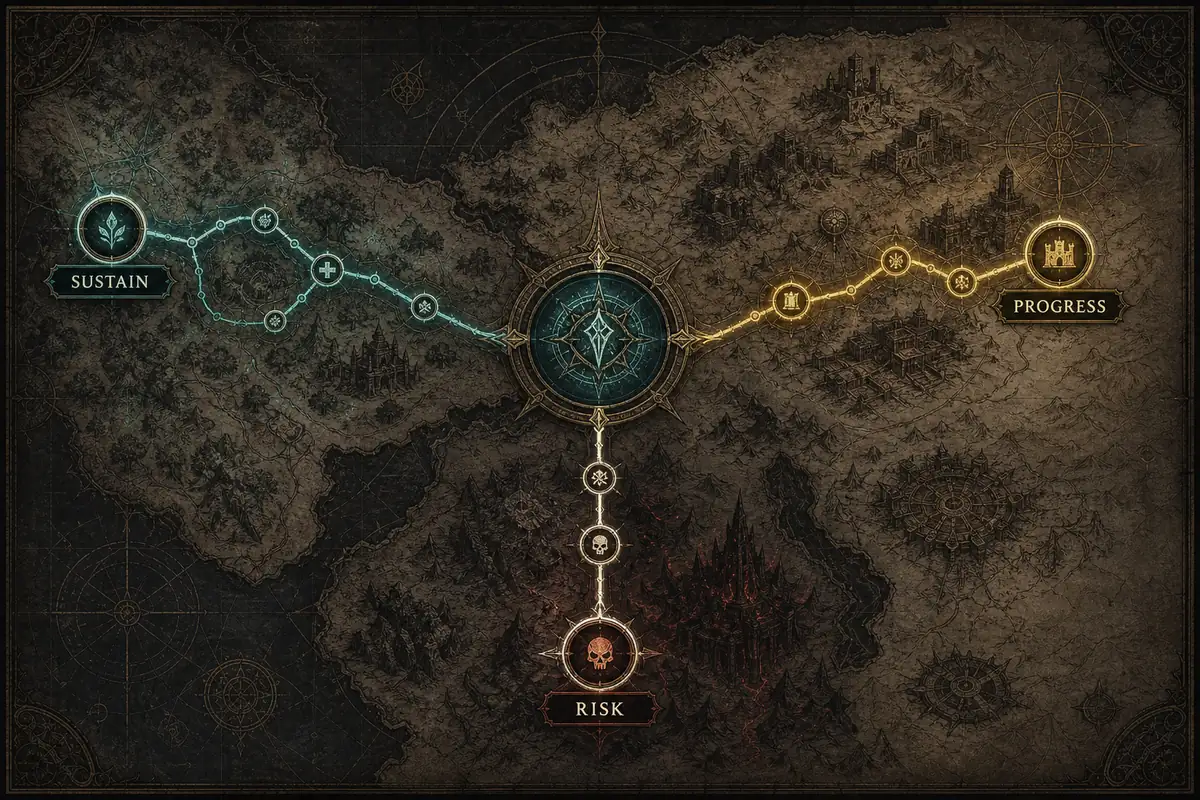
Start with the Atlas branches that keep your map loop stable and make the Ritual encounter easy to evaluate. Add reward weighting only when you can finish encounters without repeated deaths, stalled maps or a currency cost that erases the extra reward. A Ritual Atlas tree is an endgame map plan; it does not replace the character passive tree, an Ascendancy route or weapon-set points.
What a Ritual Atlas tree should solve
Ritual planning has three jobs: get the encounter to appear often enough to test, keep the map loop healthy, and turn your preferred reward profile into a route you can explain. A copied best Ritual Atlas tree can be correct for a fast, durable character and still be a poor starting point for a new character that loses maps, misses reward windows or cannot handle a crowded altar. Treat the word best as a comparison target, not a universal answer.
Keep the systems separate while you plan. Atlas passives change map and mechanic outcomes; character passives change class damage, defence, attributes and travel cost. Ascendancy points have their own trial budget, and weapon-set points have their own branch logic. Use the main PoE2 passive tree planner to audit the character route, then return here to decide whether Ritual deserves Atlas points.
Node selection order for a new Ritual route
The first points should reduce uncertainty. Look for the branch that answers how often the mechanic appears, how safely the encounter can be completed and whether the reward pool is useful for your current goal. When a tooltip is unclear or a node name changed in a recent patch, pause and check the in-game text instead of inferring the effect from an old screenshot. The route is only useful when the assumptions are visible.
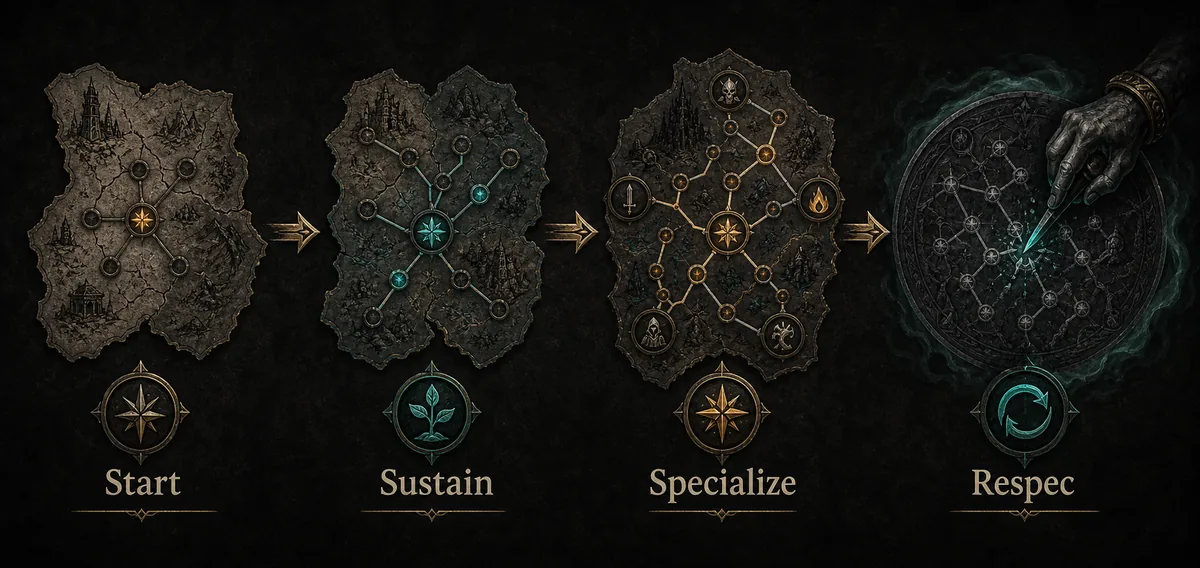
A practical test uses a short route rather than a full tree. Spend the minimum points needed to reach the branch, run five to ten comparable maps, and record encounter completion, deaths, map sustain and the type of reward you actually keep. If the result is worse than your baseline, refund the experiment before adding a second specialization. This makes the Ritual Atlas tree a measurable plan instead of a tier-list slogan.
| Planning layer | Question to answer | Pass condition |
|---|---|---|
| Encounter access | Does the mechanic appear often enough to test? | You can compare several maps without a long dry spell. |
| Completion safety | Can the build finish the altar under normal map pressure? | Deaths and abandoned encounters stay within your baseline. |
| Reward focus | Does the branch improve the reward you actually want? | The extra reward survives fees, failed maps and unused items. |
| Boss or pinnacle pressure | Does a high-risk branch match your current goal? | The character can handle the route without borrowing power from the wrong system. |
- 1Write the current map goal in one sentence: sustain, Ritual rewards, boss progress or a short experiment.
- 2Open the live Atlas tooltip and mark the minimum branch that changes the goal.
- 3Run five to ten comparable maps and record completion, deaths, map return and reward quality.
- 4Keep the branch if the result is repeatable; otherwise refund before adding another mechanic.
- 5Save the route note with the patch date so a future tree change does not look like a personal mistake.
Ritual types, areas and rewards
Search demand around Ritual types, Ritual areas and Ritual tablets is broader than the Atlas-tree query. That does not mean every related term deserves its own URL here. Use the Ritual Atlas page for the point-allocation decision, and answer mechanic vocabulary only when it helps a reader choose a branch. A short explanation of reward types, encounter density and area constraints can support the main intent without turning the guide into an encyclopedia.
The same rule applies to named items and quests such as Traveler's Woe or An Audience with the King. They are useful anchors when a reader is checking a specific reward or progression gate, but they have their own search intent. Link to an authoritative data or game reference when the exact item wording matters, and keep the Atlas page focused on how that information changes a route decision.
A three-signal Ritual route check
Use all three signals before calling a branch efficient.
When to respec a Ritual Atlas tree
Respec after a reason, not after one lucky altar. A good trigger is a stable map pool, a confirmed patch change, a switch from progression to farming, or a clear record that the current branch adds risk without useful reward. Keep a before-and-after note: which branch moved, what the character could complete, and what the new route is expected to improve. This makes it easier to undo a bad experiment and to explain the choice to a group.
Do not use an Atlas respec to repair a weak character route. If the problem is low damage, missing attributes, poor recovery or a long path to a keystone, open the passive tree planner and fix the character layer first. If the problem is map access or mechanic reward, adjust Atlas points. Separating those diagnoses prevents Ritual farming from consuming points that your build needs for survival.
Ritual Atlas decision table
| Situation | Action | Why |
|---|---|---|
| Entering endgame | Keep sustain and flexible branches | You need a stable baseline before measuring Ritual. |
| Ritual is the stated farm | Add the smallest reward branch | A short test isolates the reward change. |
| Boss or high-risk goal | Delay risky Ritual specialization | The character may need every defensive assumption elsewhere. |
| Patch or node text changed | Re-read tooltips and retest | Old routes can preserve names but not mechanics. |
Common Ritual Atlas mistakes
The most common mistake is copying a finished tree without copying its conditions. A fast mapper, a boss character and a league-start character can value the same Ritual node differently because they have different map speed, recovery, currency and tolerance for failed encounters. A second mistake is treating current window volume or a popular guide title as proof that one branch is best. Search demand tells you what players ask; it does not validate a route in your character.
Another mistake is mixing the three point systems in notes. Write Atlas points, character passives, Ascendancy points and weapon-set points on separate lines. When a Ritual branch feels expensive, compare its Atlas opportunity cost with the actual reward and with the value of improving the character route. This simple accounting rule is more reliable than adding every related keyword or every glowing node to one page.
Patch freshness and source limits
Ritual node names, reward weighting and Atlas structure can change with a patch. This page uses a cautious route method rather than claiming a permanent best tree. Before you spend points, compare the live tooltip with the route note, check the current patch context and run a short sample. Similarweb demand is directional evidence for page focus, not a gameplay balance source.
The repository is an independent fan-made planner. Official Path of Exile pages and the live client should win when wording, availability or rewards conflict with a guide. For current character routing, use the planner and the linked Atlas or Expedition guides; for a named item or quest, follow the external source and record the date you checked it.
PoE2 Ritual Atlas tree FAQ
What is the best Ritual Atlas tree in PoE2?
There is no universal best tree. Start with a stable map loop, test the smallest Ritual branch that matches your goal, and keep it only when completion and reward quality are repeatable.
Should I take Ritual nodes before Atlas sustain?
Usually not when you are still building a map pool. Sustain and completion create the baseline that lets you measure Ritual instead of mistaking a lucky map for a route.
How do I max out a Ritual Atlas tree?
Define what max means first: encounter frequency, reward quality, boss progress or a complete branch. Read the live node requirements, test in a short route and avoid spending points that your character needs for survival.
Are Ritual Atlas points the same as passive skill points?
No. Atlas points affect maps and endgame mechanics. Character passive points, Ascendancy points and weapon-set points are separate budgets.
Should I make a page for every Ritual type or reward?
No. Types, areas and named items are supporting intents here. Create a separate page only when the query has a distinct task and the site has enough verified data to answer it without cannibalizing the Atlas guide.
When should I respec Ritual Atlas points?
Respec when you have a concrete trigger such as a stable map pool, a patch change, a switch to farming or a measured mismatch between risk and reward.
Is this an official Ritual Atlas tree?
No. It is an independent route-planning guide. Confirm current node text, requirements and rewards in the live Path of Exile 2 client and official sources.
Sources and limits
The page uses the current Route Lab data boundary and Similarweb keyword evidence for topic selection. These links provide official game context; they do not replace the live Atlas tooltip or a controlled route test.
No Ritual-specific official screenshot was available in the repository or the checked public sources. The two visuals are reused site editorial diagrams and are labeled as non-official; the third visual is an HTML/CSS decision map.