PoE2 Skill Tree Starting Points: Where Every Class Begins
The PoE2 skill tree starting points are easier to understand when you separate three things: the class start circle, the first allocatable passive nodes, and the later Ascendancy wheel. This guide maps all 12 current classes to their starting regions, explains the first-ring choices, and gives you a short route test before a build becomes expensive to change.
Checked August 8, 2026 against the repository's current PoE2 0.5 tree export, official Path of Exile references, PoE2DB data, and Similarweb keyword evidence.
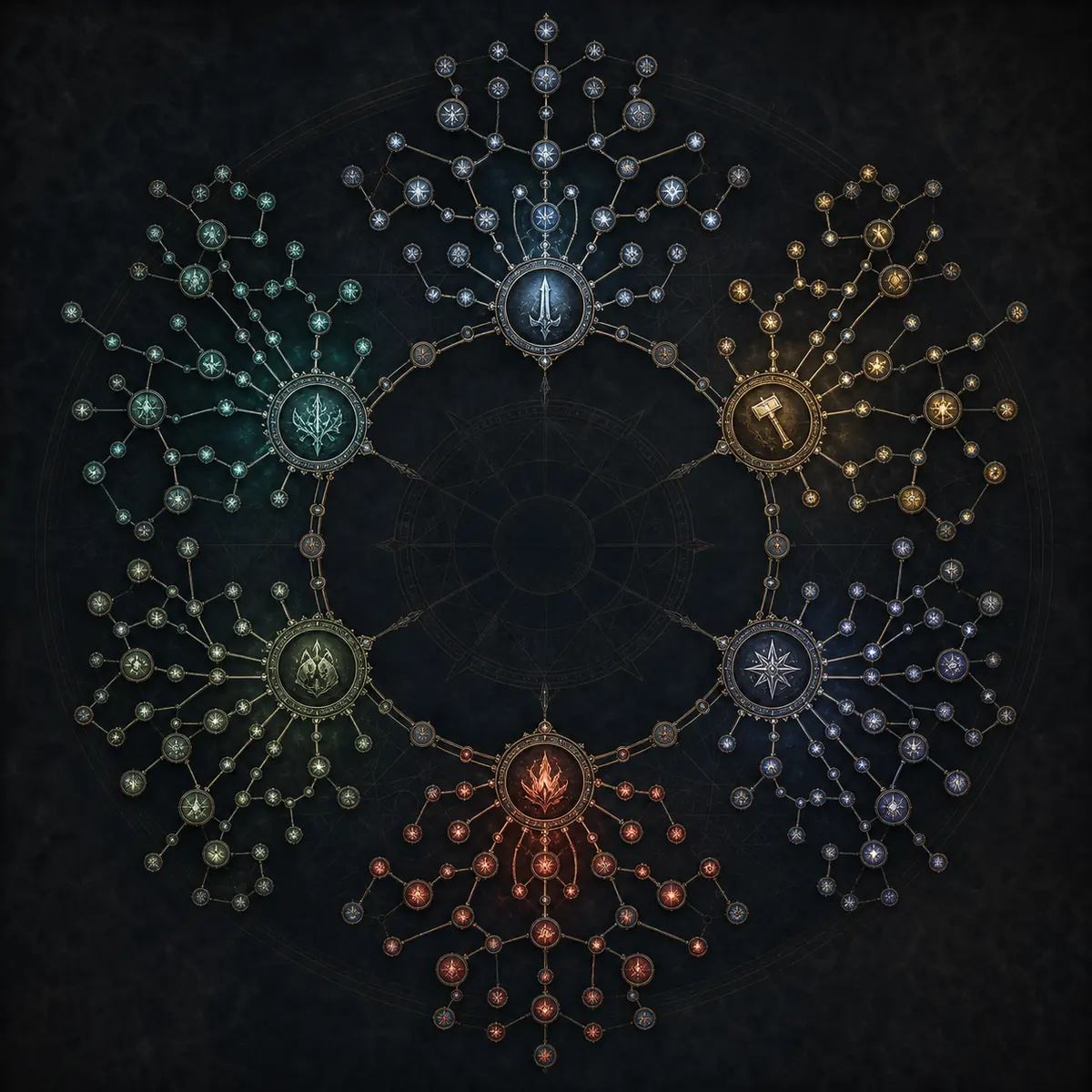
Editorial concept illustration, not an official gameplay screenshot: a class start is a region and route budget, not a build recommendation.
12Current classes in the 0.5 export
6Shared starting regions
20-30Points worth testing before a deep branch
0.5Tree version used for this map
Quick answer: class starts are fixed regions, not selectable spawn points
When you create a PoE2 character, the selected class determines the start area on the passive skill tree. You do not pick a different start circle by choosing an Ascendancy, equipping a weapon, or importing a build. You can travel widely later, but every extra connection has a point cost and a timing cost.
The current 0.5 export has 12 classes but six shared start regions. Warrior uses the Marauder start area, Sorceress uses Witch, Huntress uses Ranger, Mercenary uses Duelist, Monk uses Shadow, and Druid uses Templar. That shared geometry is useful: it tells you where to begin, but it does not mean the two classes have identical skills, overrides, or build jobs.
For the common Shadow question, look at the Shadow start area on the upper-right side of the full tree in the planner. The first named choices near that origin are the Evasion and Energy Shield and Skill Speed directions. Monk shares that region in the current export, so the correct answer is a shared start area rather than a separate Monk wheel.
This page is a route-reading guide, not a ranking of the best class or the best first node. A strong start is the one that keeps the early character functional while pointing toward its real damage, defense, recovery, attribute, and Ascendancy requirements.
The 12 PoE2 skill tree starting points in the 0.5 export
The table below uses the class-start mapping in the bundled 0.5 data. The shared region column is the important answer for players who cannot find a newer class name on an older-looking tree. The first-ring column lists the first named directions that help you read the area; it is not a promise that every build should allocate both branches.
Treat the names as current-data labels. A patch can rename a node, replace its stat text, or change the most efficient route around it. If a screenshot, video, or imported build disagrees with the live tree, open the planner and verify the current node rather than forcing the old route to fit.
The class map also explains why a broad PoE2 skill tree search belongs to the homepage planner while this page owns a narrower question. The planner lets you inspect the full route; this guide gives you the starting-area orientation before you spend time comparing a complete tree.
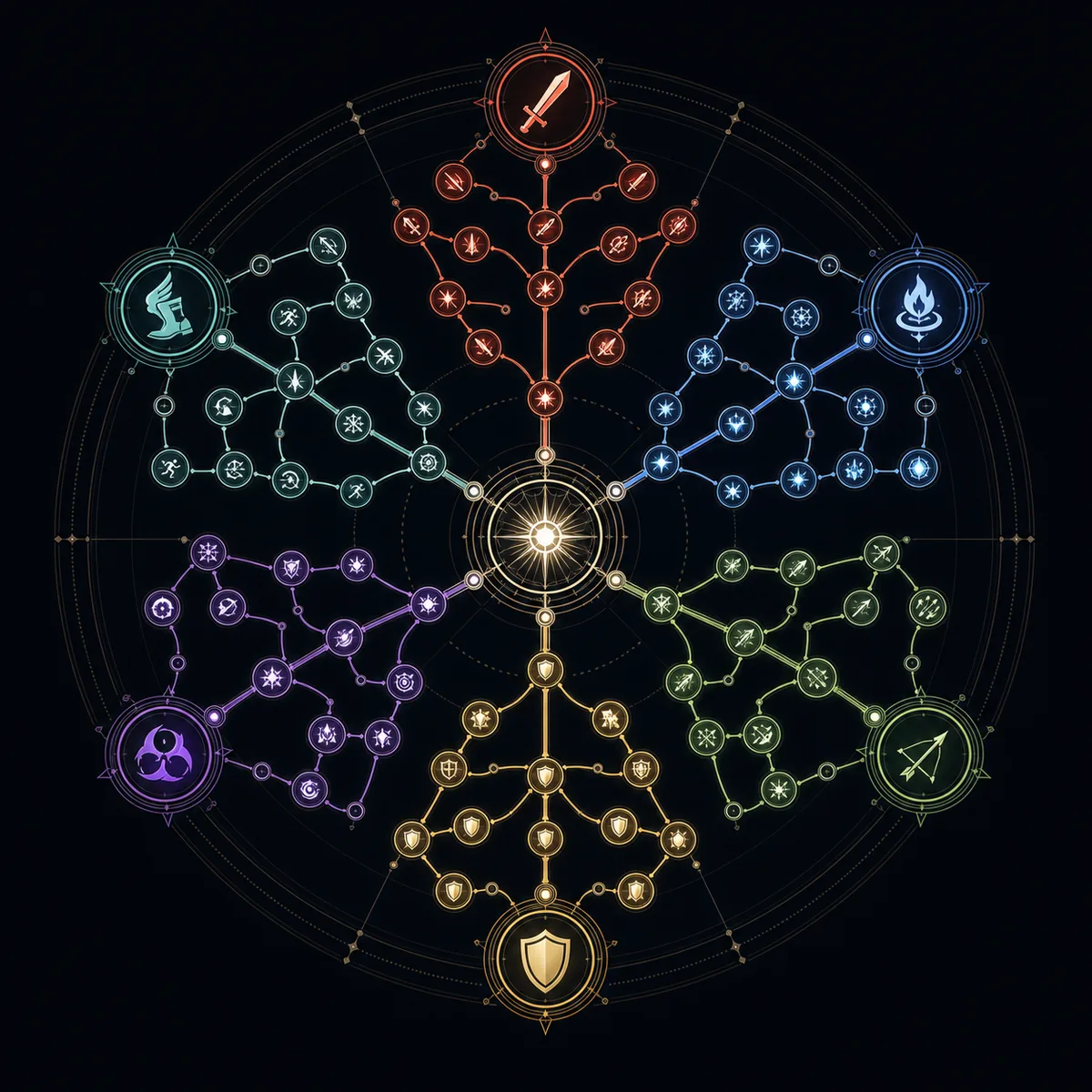
The 0.5 export maps pairs of current classes onto six shared start areas before their builds diverge through node choices.
Class, shared start region, and first named directions
Class
Shared start region
First named directions
How to use the information
Marauder
Marauder area
Melee Damage; Armour
Choose the branch that keeps the early skill and defense budget balanced.
Witch
Witch area
Spell Damage; Energy Shield
Check spell scaling against recovery and the defensive floor.
Ranger
Ranger area
Evasion; Projectile Damage
Use projectile travel only when the skill and weapon plan support it.
Duelist
Duelist area
Armour and Evasion; Projectile Damage
Treat the hybrid start as a flexible base, not a forced projectile route.
Shadow
Shadow area
Evasion and Energy Shield; Skill Speed
This is the upper-right start answer for the common Shadow question.
Templar
Templar area
Spell and Attack Damage; Armour and Energy Shield
Compare the damage mode with the defense layer the build can actually sustain.
Warrior
Marauder area
Melee Damage; Armour
The newer class name maps to the existing Warrior/Marauder start geometry.
Sorceress
Witch area
Spell Damage; Energy Shield
Look for the Witch-region start before searching for a separate Sorceress circle.
Huntress
Ranger area
Evasion; Projectile Damage
The shared Ranger-region start is the right place to inspect first-ring options.
Mercenary
Duelist area
Armour and Evasion; Projectile Damage
The start is shared even though the later class and weapon decisions differ.
Monk
Shadow area
Evasion and Energy Shield; Skill Speed
Monk uses the Shadow-region geometry in the current export.
Druid
Templar area
Spell and Attack Damage; Armour and Energy Shield
The hybrid Templar-region start is a map location, not an Ascendancy choice.
How to read the first ring after a class start
The start circle itself is an orientation marker. The first allocatable ring is where the practical decision begins. Read each branch by its job, not by the biggest number in one tooltip. Early damage can make a campaign skill feel better, while a defensive or attribute node can be the difference between a route that works now and a route that only works after ideal gear arrives.
For Warrior and Marauder, the current area exposes a melee-damage direction and an armour direction. For Witch and Sorceress, spell damage and energy shield are the first obvious questions. Ranger and Huntress begin around projectile damage and evasion. Duelist and Mercenary share a hybrid armour/evasion area with a projectile-oriented option. Shadow and Monk combine evasion/energy shield with skill speed. Templar and Druid have a hybrid spell/attack and armour/energy-shield choice.
Do not confuse an Ascendancy start node with the class start. Ascendancy wheels sit away from the normal tree and use Ascendancy points earned through trials. They are a later specialization budget, while the first-ring nodes use normal passive planning unless a specific weapon-set allocation applies. Keep the two budgets separate in notes and in exported builds.
A useful first-ring comparison has three columns: what the node improves, what defensive or attribute requirement it delays, and whether it still makes sense at the next 10 points. That simple comparison is more reliable than copying a completed endgame tree as a leveling route.
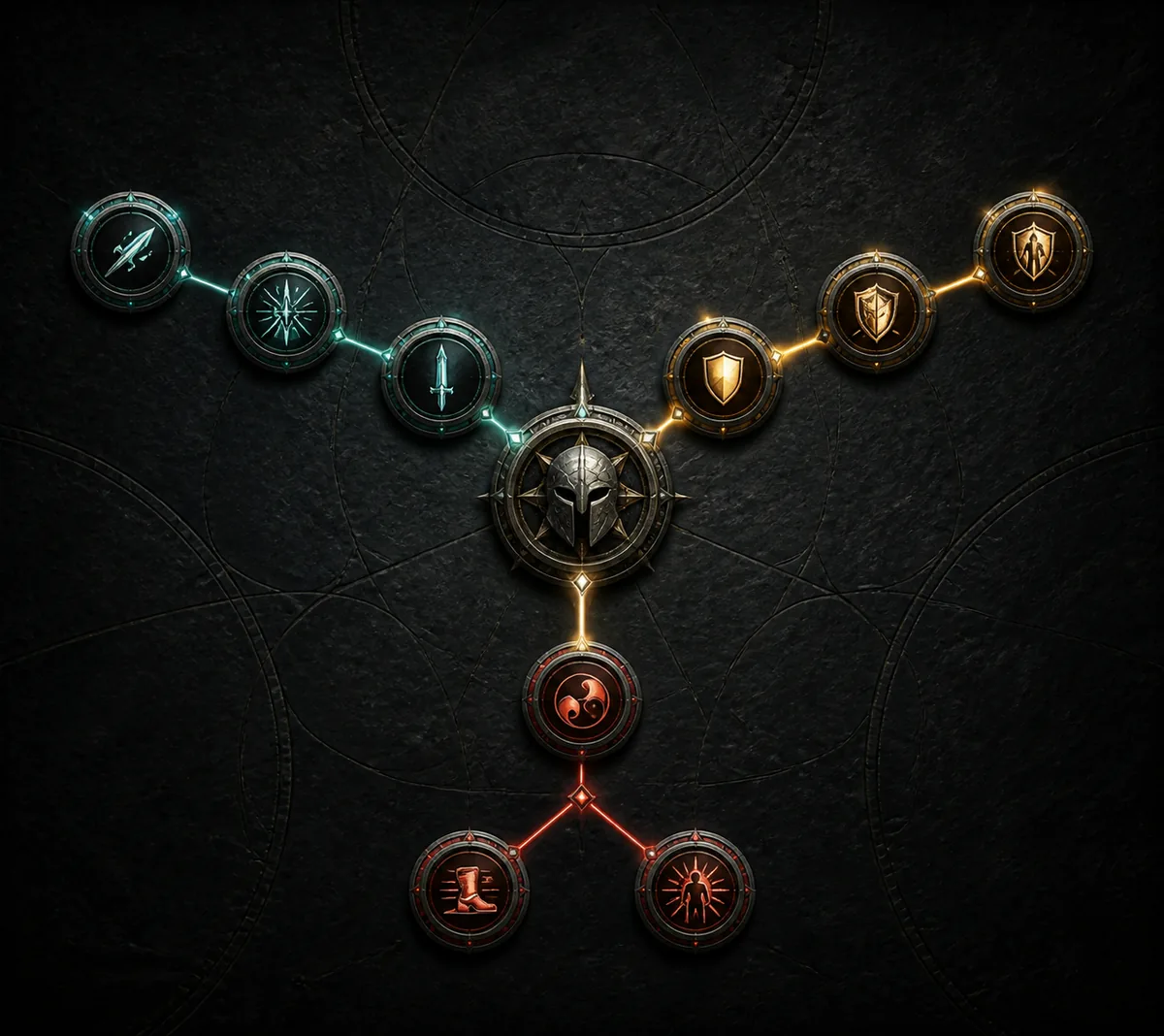
A first-ring decision is a tradeoff: compare the job of the next few nodes before chasing a distant notable.
A practical 20-30 point workflow for any starting area
Start with the class and Ascendancy that the character will actually use. Then save a baseline route after the first few connection nodes. The baseline should include the minimum damage loop, an early defensive floor, required attributes, and any recovery or resource mechanic the skill needs. Without that baseline, a distant notable can look efficient simply because its travel cost is hidden.
Next, test one first-ring direction at a time. Count every point that exists only to reach the branch, but also mark travel nodes that solve a real attribute or defense problem. Compare the route at roughly 10, 20, and 30 allocated points. If the branch is only attractive at the final tree, label it as a later goal instead of treating it as the starting route.
Finally, test the transition out of the start area. The best first branch should leave at least one sensible connection toward the build's next cluster. If a route consumes points on early damage but strands the character away from defenses, recovery, or the required Ascendancy direction, the local tooltip is not enough to justify it.
Use the interactive planner to verify exact node names and connections, then compare named notables with their full travel cost. For a 0.5 update, check the changes overlay before importing an old route. If the build also uses weapon-set points, keep those allocations outside the normal starting budget until the shared route is legal.
Step
Question
Pass condition
1. Class
Is the selected class and shared region correct?
The start circle and current 0.5 class mapping match the planner.
2. First ring
What job does each nearby branch perform?
Damage, defense, attribute, or utility value is explicit.
3. Budget
What does the route cost at 10, 20, and 30 points?
Travel nodes and delayed defenses are visible.
4. Exit
Where does the branch connect next?
The next cluster is reachable without a dead-end detour.
5. Patch
Does the current 0.5 tree still match the source?
Names, stats, and connections are checked before export.
Common starting-point mistakes
The first mistake is searching for a newer class name in the wrong visual area. The export can intentionally reuse a base start region, so look for the shared geometry and then apply the class-specific data. The second is assuming that a class start determines the whole build. It determines the opening distance; it does not decide which damage engine, defensive layer, or late-game notable is correct.
The third mistake is treating the first named node as mandatory. A branch can be close and still be wrong for the skill, weapon, attribute requirements, or defense timing. Check the next connection and the next budget before committing. The fourth is counting Ascendancy, campaign reward, Atlas, and weapon-set points as if they were normal level-up points.
If an older guide points to a different location, compare the class start, first-ring stats, node names, and connections against the current 0.5 tree. Use the 0.5 changes page for the patch-difference summary and the planner for the final route.
PoE2 skill tree starting point FAQ
Where is the Shadow starting point in PoE2?
Shadow starts in the Shadow-region area on the upper-right side of the full passive tree in the planner. Monk shares that region in the current 0.5 export. The first named directions are Evasion and Energy Shield and Skill Speed.
Can I choose a different class starting point?
No. Your selected class determines the normal tree start. You can travel to other regions later, but every connection consumes passive points and may delay defenses or attributes.
Do Ascendancies change the class starting point?
No. Ascendancy choices open a separate specialization wheel and use Ascendancy points. They can change the value of a route, but they do not move the normal class start circle.
Why do Warrior and Sorceress use older-looking start names?
The current export maps newer classes onto shared start regions: Warrior to Marauder, Sorceress to Witch, Huntress to Ranger, Mercenary to Duelist, Monk to Shadow, and Druid to Templar. The shared map is intentional; class-specific data still needs a current check.
How many points should I test before leaving the start area?
Compare the route at about 10, 20, and 30 allocated points. This is a planning checkpoint, not a hard game rule. Move on when the branch supports the next cluster and the character still has its required damage, defense, attributes, and recovery.
Is this a list of the best first passive nodes?
No. It is a starting-point map and route-reading guide. The best first node depends on the skill, weapon, Ascendancy, item assumptions, defensive layer, and the current patch.
What should I do when an old build starts somewhere else?
Check the 0.5 changes overlay, search the old node names, and compare the current class start plus connections in the planner. Do not allocate from a screenshot until the live tree agrees with it.
Sources and data note
This page is an independent planning guide. The class map and first-ring examples are derived from the repository's current PoE2 0.5 tree export. Official game context and public data references are linked below; patch notes and the in-game tree should win when sources disagree.