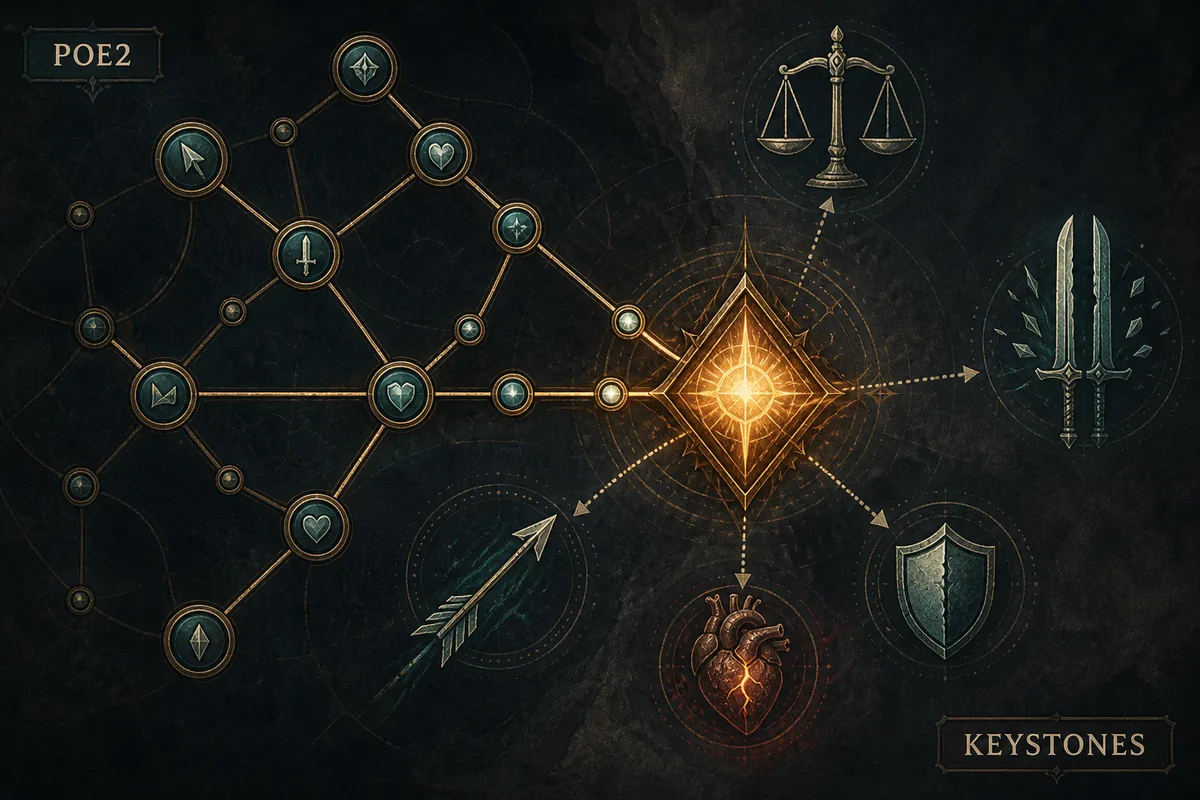
The current PoE2 0.5 tree contains 33 character keystones. This list shows their recorded effects, but the useful decision is not which tooltip looks strongest. A keystone is worth a point only when the rest of the build can pay for its rule change, opportunity cost, and defensive consequences.
Checked on August 10, 2026 against the repository's 0.5 tree export, Similarweb keyword data, PoE2DB passive data, and current public Path of Exile sources.
Quick answer: take a PoE2 keystone only when the whole build can support its new rule
PoE2 keystones are special passive nodes that rewrite a rule instead of adding one more ordinary stat line. Avatar of Fire converts damage, Blood Magic changes the resource used by skills, Chaos Inoculation sets maximum life to one, and Giant's Blood changes which weapons you can wield. These are build architecture decisions, not small upgrades.
The safest test is to state the build job and the cost in one sentence. For example: Mind Over Matter lets this mana-defence route absorb damage before life, but it requires enough mana recovery and changes how every hit is evaluated. If you cannot name the mechanic that becomes better and the layer that becomes harder, the node is not ready to take.
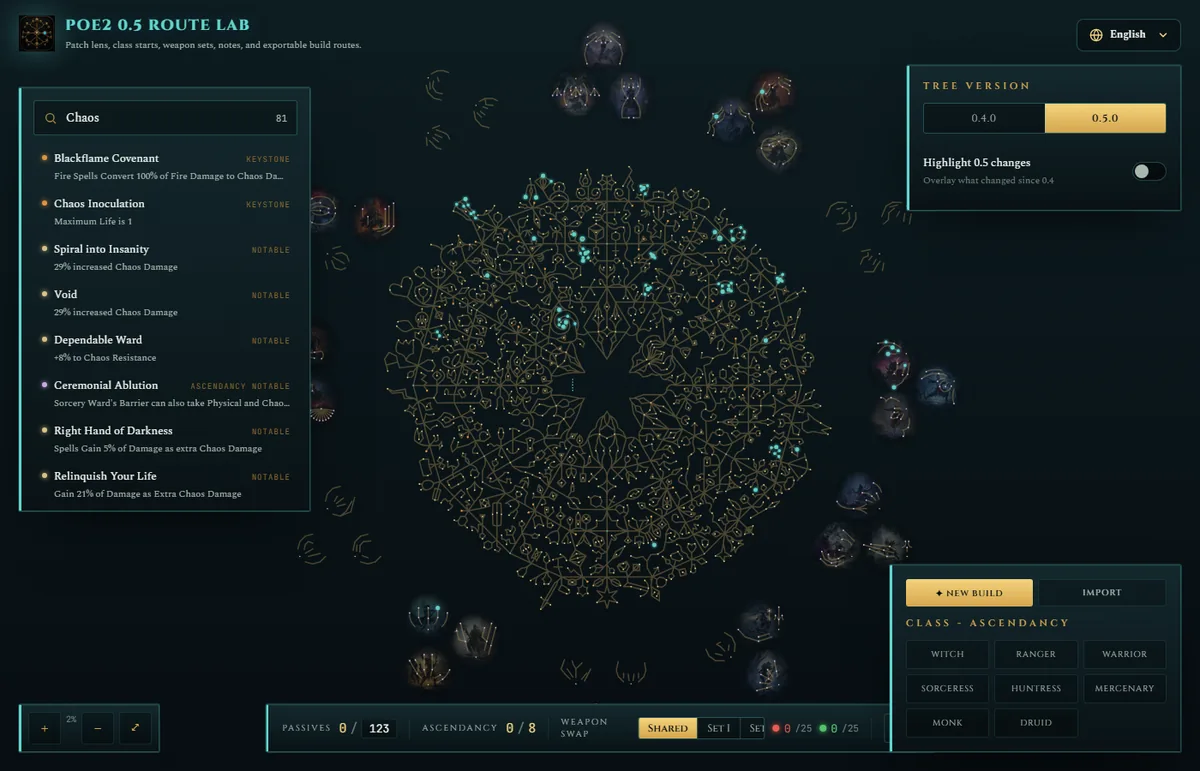
Use this page as a current 0.5 reference list, then open the Route Lab and search the exact node name. The planner is the right place to count travel points, compare class starts, inspect nearby defenses, and record whether the route still works at your actual leveling or endgame budget.
Why keystones are different from notables, jewel sockets, and ascendancy nodes
A notable usually concentrates a strong benefit inside a cluster. A jewel socket creates an item decision. An ascendancy node belongs to a separate specialization tree and uses ascendancy points. A keystone changes a rule that can reach across damage, recovery, resources, equipment, charges, minions, or movement. Treating all four node types as interchangeable makes the passive budget look healthier than it is.
The route cost also needs a wider definition. Count the small nodes required to reach the keystone, then inspect the gear, support gems, attributes, recovery, and defensive timing that its effect changes. A node can be close on the tree and still be expensive if it forces a complete item or resource redesign.
Current PoE2 keystones list from the 0.5 tree export
The table below is generated from the repository's current data-0.5.json export and includes character keystones, not ascendancy notables. Effect text is normalized from the source markup for readability; the official game data and the in-game tooltip remain the final authority when a patch changes wording.
Use the list to find a mechanic, not to create a blind ranking. A keystone with a high headline number may lose value when it disables a recovery method, adds a resource cost, blocks a movement option, or demands equipment that your build cannot afford.
Keystone
Recorded 0.5 effect
Ancestral Bond
Your Totem Limit is doubled No cost or Charge requirement for placing Totems Totems reserve 75 Spirit each
Avatar of Fire
75% of Damage Converted to Fire Damage Deal no Non-Fire Damage
Blackflame Covenant
Fire Spells Convert 100% of Fire Damage to Chaos Damage Chaos Damage from Fire Spells Contributes to Flammability and Ignite Magnitudes Ignite inflicted with Fire Spells deals Chaos Damage instead of Fire Damage
Blood Magic
You have no Mana Skill Mana Costs Converted to Life Costs
Bulwark
Dodge Roll cannot Avoid Damage Take 30% less Damage from Hits while Dodge Rolling
Chaos Inoculation
Maximum Life is 1 Immune to Chaos Damage and Bleeding
Conduit
If you would gain a Charge, Allies in your Presence gain that Charge instead
Crimson Assault
Bleeding you inflict is Aggravated Base Bleeding Duration is 1 second 50% more Magnitude of Bleeding you inflict
Dance with Death
25% more Skill Speed while Off Hand is empty and you have a One-Handed Martial Weapon equipped in your Main Hand
Eldritch Battery
Convert 100% of maximum Energy Shield to maximum Mana Mana Costs are Doubled
Elemental Equilibrium
Create Lightning Infusion Remnants instead of Fire Create Cold Infusion Remnants instead of Lightning Create Fire Infusion Remnants instead of Cold
Eternal Youth
Life Recharges instead of Energy Shield 50% less Life Recovery from Flasks
Giant's Blood
You can wield Two-Handed Axes, Maces and Swords in one hand Triple Attribute requirements of Martial Weapons Inherent Life granted by Strength is halved
Glancing Blows
Chance to Evade is Unlucky Chance to Deflect is Lucky
Heartstopper
Take 50% less Damage over Time if you've started taking Damage over Time in the past second Take 50% more Damage over Time if you haven't started taking Damage over Time in the past second
Hollow Palm Technique
Can Attack as though using a Quarterstaff while both of your hand slots are empty Unarmed Attacks that would use an Equipped Quarterstaff's damage have: • Base Unarmed Physical damage replaced with damage based on their Skill Level • 1% more Attack Speed per 75 Item Evasion on Equipped Armour Items • +0.1% to Critical Hit Chance per 10 Item Energy Shield on Equipped Armour Items
Iron Reflexes
Converts all Evasion Rating to Armour
Lord of the Wilds
You can equip a non-Unique Sceptre while wielding a Talisman 50% less Spirit Non-Minion Skills have 50% less Reservation Efficiency
Mind Over Matter
All Damage is taken from Mana before Life 50% less Mana Recovery Rate
Necromantic Talisman
All bonuses from Equipped Amulet apply to your Minions instead of you
Oasis
Cannot use Charms 30% more Recovery from Flasks
Pain Attunement
30% less Critical Damage Bonus when on Full Life 30% more Critical Damage Bonus when on Low Life
Primal Hunger
100% more Maximum Rage Regenerate 1 Rage per second per 4 Rage spent Recently No Rage effect
Resolute Technique
Accuracy Rating is Doubled Never deal Critical Hits
Resonance
Gain Power Charges instead of Frenzy Charges Gain Frenzy Charges instead of Endurance Charges Gain Endurance Charges instead of Power Charges
Ritual Cadence
Invocation Skills instead Trigger Spells every 2 seconds Invocation Skills cannot gain Energy while Triggering Spells Invoked Spells consume 50% less Energy
Scarred Faith
5% of Physical Damage prevented Recouped as Energy Shield per enemy Power Energy Shield does not Recharge You cannot Recover Energy Shield from Regeneration You cannot Recover Energy Shield to above Armour
Trusted Kinship
You can have two Companions of different types 30% more Reservation Efficiency of Companion Skills 20% less Reservation Efficiency of non-Companion Skills
Unwavering Stance
Cannot be Light Stunned Cannot Dodge Roll or Sprint
Vaal Pact
50% more amount of Life Leeched Leech Life 67% less quickly Cannot Recover Life other than from Leech Life Leech effects are not removed when Unreserved Life is Filled
Whispers of Doom
You can apply an additional Curse Double Activation Delay of Curses
Wildsurge Incantation
Storm and Plant Spells: • deal 50% more damage • cost 50% less • have 75% less duration
Zealot's Oath
Excess Life Recovery from Regeneration is applied to Energy Shield Energy Shield does not Recharge
7 checks before spending points on a PoE2 keystone
Run these checks before copying a route from a video, forum post, or old build file. They separate an attractive rule change from a route that survives real play. You do not need every answer to be perfect, but an unanswered downside should be treated as a build risk rather than a hidden benefit.
Repeat the audit at more than one budget. A keystone can be correct for an endgame version and still be a poor choice during the campaign because the required attributes, recovery, weapon, or support setup does not exist yet. Mark the point at which the node becomes legal and useful instead of forcing it into the first route.
Check
Question to ask
Pass condition
Build job
What rule does this keystone improve?
You can state one concrete damage, defense, resource, equipment, or utility job.
Downside
What does the node disable, reduce, or make harder?
The downside is visible in the route and gear plan, not hidden in a tooltip.
Travel cost
How many points exist only to reach the node?
Useful travel and dead travel are counted separately.
Resource and recovery
Does it change life, mana, energy shield, charges, or recovery?
The build has a tested way to pay the new resource or recovery rule.
Equipment
Does the node require a weapon, empty slot, jewel, or unique?
The equipment assumption is available at the budget where the node is taken.
Timing
Is this a leveling node or a later milestone?
The route remains functional before the final item and point budget arrive.
Exit plan
Can you refund it without breaking the whole route?
A fallback branch or refund plan exists if the mechanic underperforms.
How to test keystones in the PoE2 passive tree planner
Open the Route Lab, select the class and ascendancy that the character actually uses, and search for the keystone by name or mechanic. Start with a baseline route that contains class travel, attributes, a defensive floor, recovery, and the minimum damage loop. Save the point total before adding the rule change.
Add one keystone at a time and recount the entire branch. Check which travel nodes are genuinely useful, which defenses move later, and whether the new rule changes the value of nearby notables or jewel sockets. If the route only works after assuming perfect gear, treat the keystone as a later target rather than a leveling instruction.
Finally, test the route with both weapon-set states when the build uses conditional allocations. Weapon set points and ascendancy points are separate budgets. They can specialize a legal route, but they should not be used to hide the fact that the normal passive route cannot reach the keystone.
First-party Route Lab screenshot: search by a keystone name or mechanic before adding it to a route.
Choose the real class and ascendancy before opening the tree.
Search the keystone by name and read the full effect, including every downside.
Build and save a legal baseline route with defense, recovery, attributes, and core damage.
Add one keystone, recount travel, and compare the route at campaign and endgame budgets.
Export only after normal passives, weapon-set points, ascendancy points, and Atlas points are separated.
First-party Route Lab screenshot: count the complete branch and check nearby defenses before committing points.
Patch freshness and data limits
The 0.5 list is a snapshot of the tree export bundled with this site. It is useful for finding names and reading the current recorded stat lines, but it is not a promise that every build recommendation remains correct after a balance patch. A renamed or reworked keystone can preserve a familiar search term while changing the route decision underneath it.
When sources disagree, compare the in-game tooltip, official Path of Exile update notes, the current public export, and the planner's displayed route. PoE2DB is helpful for browsing node records, while this Route Lab is useful for seeing travel pressure. Record the patch and the reason for the choice in build notes so an old route can be audited later.
Common PoE2 keystone mistakes
The first mistake is choosing from the name alone. Avatar of Fire, Blood Magic, and Chaos Inoculation each make a clear promise, but each also removes or changes options that the rest of the build may rely on. The second mistake is counting only the node itself and ignoring travel, attributes, recovery, and the opportunity cost of the points spent before it.
The third mistake is copying an endgame keystone into a campaign route. If the node needs a specific unique, a large mana pool, a complete energy-shield setup, or a mature damage loop, label it as a milestone. The fourth is mixing character keystones with ascendancy notables or Atlas passives. Keep those trees and point pools separate in the planner and in any exported build notes.
How many keystones are in the PoE2 0.5 passive tree?
The repository's current 0.5 character-tree export contains 33 keystone nodes outside the ascendancy wheels. Recheck the in-game tree after a patch.
What are PoE2 keystones?
They are special passive nodes that change a core rule, such as damage conversion, resource use, recovery, charges, equipment, or maximum life. Their downsides are part of the decision.
Where can I find a PoE2 keystones list?
Use the list on this page for the current bundled 0.5 data, then search the exact node in the Route Lab and verify the tooltip against current public sources before spending points.
Are keystones the same as notable passives in PoE2?
No. Notables usually provide a named cluster payoff. Keystones rewrite a rule and often require a wider change to gear, resources, defenses, or damage scaling.
Should I take a keystone while leveling?
Only when the effect is useful with your current gear and recovery. Many keystones are better treated as milestones because their supporting items or resource pool arrive later.
Can weapon set points or ascendancy points pay for a keystone?
Keep the budgets separate. A keystone on the character passive tree normally needs the relevant normal route; conditional points should not be used to make an otherwise invalid path look complete.
Sources and verification
This page is an independent fan reference. Use these first-party and public data sources to verify patch-sensitive node wording before making a high-cost respec.